triangle circle square diamond

Exhibitions

Summer of Love | Art Space Pythagorion, Samos

The exhibition borrows its title from the sociocultural phenomenon that took place fifty years ago in the summer of 1967. While in Europe 1968 might have more of a legendary status due to the student uprisings in Paris and the Prague ‘Spring’, 1967 was in many ways a more seminal year in terms of geopolitical, cultural and intellectual developments. It was the year of the Six-Day War, which irrevocably changed the landscape in the Middle East; the effects of this are still being felt today. In Greece it was the year that marked the beginning of the seven-year military dictatorship. Ironically, it was also the year that the UK applied for EEC membership. In the US, 1967 also saw the first major political protests by young people against the war in Vietnam. At the same time the outburst of new popular and subcultural music was also one of the defining features of the ‘Summer of Love’.

The exhibition Summer of Love will reflect on the unlikely liaison of love and politics, connecting the summer of 1967 to the world in 2017, where the idea of love – at least in intellectual but also political circles – is dismissed as naïve and sentimental. It is a mystery why, since love is one of the most potent – and complex – forces of human life. The exhibition Summer of Love will draw on these ideas and weave a web of cultural and historic reference points in order to link the ideas of fifty years ago to the present European crisis point, and perhaps inspire us to imagine a way out of the current political impasse. It is an opportune moment to do this. Fifty years have gone by; the postwar baby boomers are ageing and dying, and their youthful ideals have largely died out. We might ask: what went wrong, when and why? What lessons can we learn? Should we rethink these ideals? Can we learn from the experiences and disappointments of the generation of 1967? In a world that rapidly seems regressing, it is time for checks and balances in order to learn from history and to avoid making the same mistakes again.

Including works by Nicolas Kozakis, Raoul Vaneigem, Johan Grimponprez, Mikhail Karikis, Mäetamm, Uriel Orlow, and Marge Monko.

Curated by Katerina Gregos


External Link →

Propositions for a Stage: 24 Frames of a Beautiful Heaven | Institute of Contemporary Arts, Singapore

Propositions for a stage: 24 frames of a beautiful heaven looks to the limits of time and the possibilities for time’s staging. Here the idea of ‘staging’ refers both to artists’ use of performance and questions of time as haunting, as stasis, as a looping repetition. This experience of time is most familiar to us through its presentation in forms of theatre and, most particularly, film, where the mechanical structure of analogue film suggests the idea of both continuous and discontinuous temporalities. The stage, set and scene provide us with a space-time apart from the everyday: a speculative world. If we think of the filmstrip as a series of discrete frames that might be chopped up, rearranged and layered then time might not always run forward but instead be characterised by stops and breaks where the past leaks into the present and the future.

Curated by Dr. Bridget Crone, including works by Amanda Beech, Zach Blas, Rabih Mroué, Uriel Orlow and Ming Wong.


External Link →

Document Bilingue | Mucem, Marseille

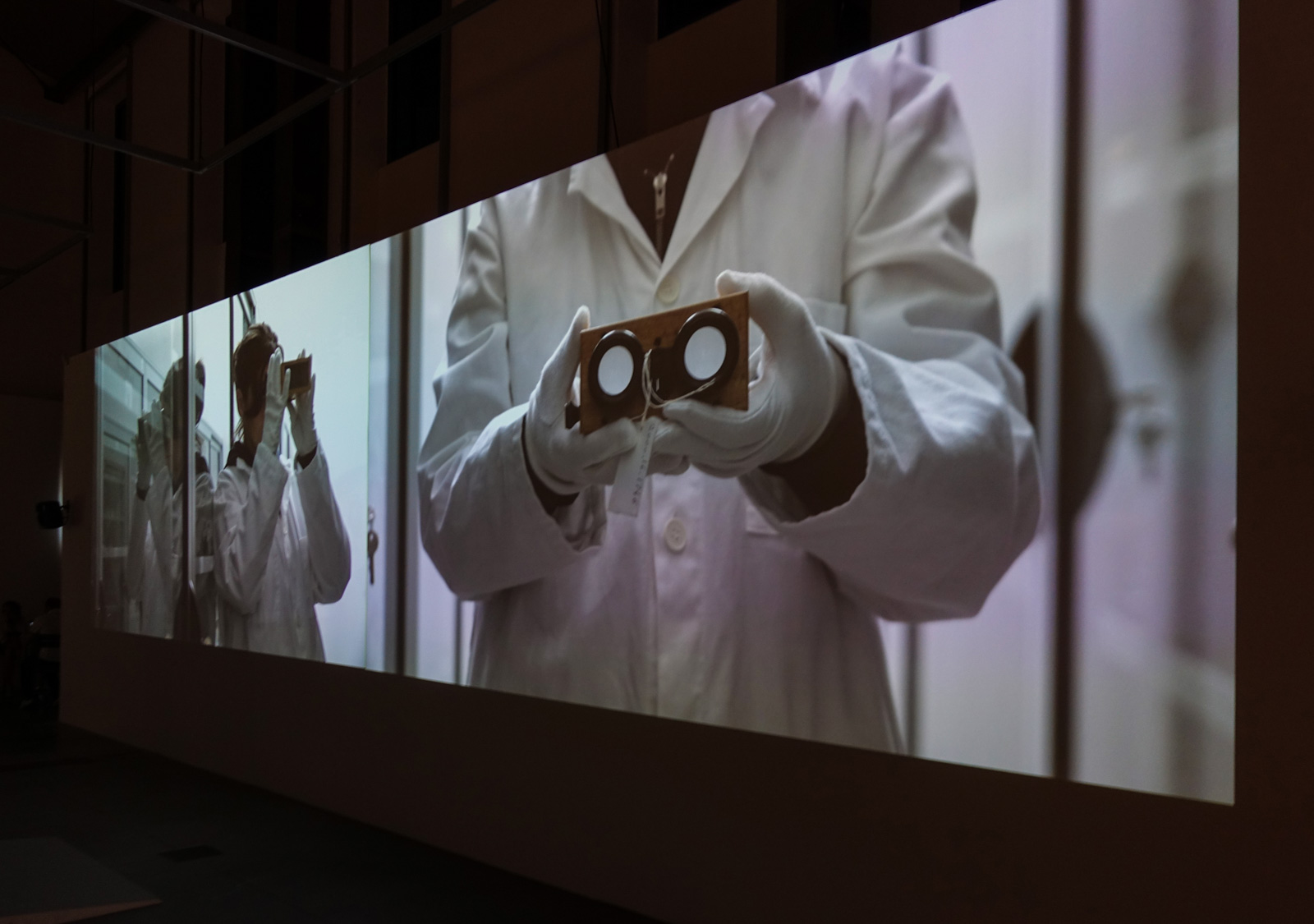
Following the residencies and preparatory workshops that began in 2015, artists and researchers are presenting an unprecedented rousing of the Mucem’s collections through Bilingual document: a dual exhibition presented at Fort SaintJean and the Centre for Conservation and Resources, featuring a sound walk that links the two sites and a book.

The Mucem houses in its reserves the collections from the former Musée National des Arts et Traditions Populaires, created in 1937 by Georges Henri Rivière. Artisanal or preindustrial vestiges of a bygone era, the objects assembled here are the bounty of methodical collections conducted during field surveys, enriched by objects acquired since the opening of the museum. The question of the dual nature of the object, split between popular art and scientific discourse, was at the heart of Rivière’s project. But what about these collections now dormant in the Mucem’s reserves? An uneasy feeling seizes visitors at the sight of these curious and sometimes obsolete time capsules. While a few objects may be called upon for a specific exhibition, how can we mobiliser the collection in a more general way within the framework of a museum of civilisation? How can we activate a document, even make it perform, by reflecting its bilingual nature: an object with an aesthetic or poetic status, while also testifying to its ethnographic value? Could art be, paradoxically, the way of reviving these trophies?

Including works by Jean-François Chougnet, Yo Barrada, Omar Berrada and M’barek Bouhchichi, Jean-Roch Bouiller, Marie-Charlotte Calafat, Erik Bullot, Sabrina Grassi, Yaël Kreplak, Franck Leibovici, Florent Molle, Uriel Orlow, Abril Padilla and Pascal Riviale.

Curated by Sabrina Grassi and Guest Curator Erik Bullot


External Link →

VIDEOEX Festival | Zürich

VIDEOEX is the only festival in Switzerland that explicitly devotes itself to experimental film and video production and presents it in a cinematographic framework.
For nine days VIDEOEX presents refreshing, uncompromising, great, ingeniously simple and exhilaratingly complex experimental films and videos: works beyond the conventional narrative cinema.

Festival Director Patrick Huber


External Link →

The International Short Film Festival Oberhausen | Oberhausen, Germany

In its 2017 Theme programme the International Short Film Festival Oberhausen looks at the history of utopian hope universally pronounced to be dead in our present day and age

“Why we’re losing the Internet to the culture of hate”, the cover of the August 2016 issue of Time magazine read. Ever since Donald Trump won the US elections, the prevalent topic of discussion is whether the internet is a failed utopia. But exactly what kind of utopia is this and what types of participatory media existed before the internet? In its Theme programme ‘Social media before the internet’, curated by Tilman Baumgärtel, Oberhausen will look at pre-digital forms of media by everyone for everyone and ask whether current developments were already foreshadowed in the early media experiments and what these can contribute to a re-assessment of our current situation.

Curated by Tilman Baumgärtel, including works by Yi Cui, Chai Siris, Zhong Su, Ayo Akingbade, Amber Bemak, Nadia Granados, Boris Poljak, Ivan Jose Murgic Capriotti, Sofia Lena Monardo, Zhong Su, Ico Costa, Hao Jingban, Philippa Ndisi-Herrmann, Katie Davies, Jovana Reisinger, Ulu Braun, Laurentia Genske, Uriel Orlow, Tim Nowitzki, Kerstin Honeit, Markus Mischkowski, Kai Maria Steinkühler, Moïra Himmelsbach, Eszter Jánka, Dean Ruddock, Aude Cuenod, Martin Turk, John Sheedy, Antoneta Kusijanović, Naghmeh Farzaneh, Claire Randall, Egil Pedersen, Christoph Girardet, DJ Hell, Zeljko Vidovic, and Mariola Brillowska


External Link →

Sharjah Biennial 13: Tamawuj | Sharjah Art Foundation, Sharjah

The thematic focus of SB13 is grounded in the four keywords water, crops, earth and culinary, which form the foundations of social interaction and exchange. Just as the thematic keywords are porous and feed into one another, SB13 places researchers and interlocutors in conversation with one another, and with Sharjah. Its multi-city, multi-part programmes are envisaged as infrastructures to channel knowledge transmission and information sharing between artists, curators, editors, researchers and the general public. This fluidity of knowledge irrigates new, enduring terrains of collaboration and references the threefold meaning of Tamawuj: a rising and falling in waves; a flowing, swelling, surging or fluctuation; and a wavy, undulating appearance, outline or form.

Sharjah Art Foundation (SAF) is pleased to announce the list of over 60 artists participating in Act I of the forthcoming Sharjah Biennial 13, Tamawuj (SB13):

Noor Abuarafeh, Lawrence Abu Hamdan, Abbas Akhavan, Tamara Al Samerraei, Allora & Calzadilla, Maria Thereza Alves, Kader Attia, Tonico Lemos Auad, Ismaï l Bahri, Sarnath Banerjee, Yto Barrada, Abdelkader Benchamma, Ursula Biemann and Paulo Tavares, Dineo Seshee Bopape, Jonathas de Andrade, Mariana Castillo Deball, Roy Dib, Vikram Divecha, Barış Doğrusöz, Koo Donghee, İ nci Eviner, Em’kal Eyongakpa, Harun Farocki, Fehras Publishing Practices, Future Farmers, Daniele Genadry, Deniz Gul, Shadi Habib Allah, Taloi Havini, Takashi Ishida, İz Öztat and Fatma Belkıs Işık, Lamia Joreige, Christoph Keller, Samir Khaddaj, Mahmoud Khaled, Nesrine Khodr, Basim Magdy, Metahaven, Hind Mezaina, Mochu, Oscar Murillo, Joe Namy, Uriel Orlow, The Otolith Group, Christodoulos Panayiotou, Khalil Rabah, Raqs Media Collective, Stéphanie Saadé, Abdullah Al Saadi, Natascha Sadr Haghighian, Ghassan Salhab, Roy Samaha, Massinissa Selmani, Setareh Shahbazi, Nida Sinnokrot, Walid Siti, Monika Sosnowska, Zhou Tao, Mario Garcí a Torres, Jorinde Voigt, James Webb, Rain Wu and Eric Chen, Paola Yacoub, Fathi Zamroud

Sharjah Biennial 13 is curated by Christine Tohme


External Link →

belong and observe | FMAC, Geneva

Group exhibition curated by Bénédicte Le Pimpec and Isaline Vuille with Sylvie Boisseau & Frank Westermeyer, Christoph Draeger, Christy Gast, Alexandra Navratil, Uriel Orlow, Jean Painlevé. From Tierra del Fuego to South Africa by way of Germany, belong and observe – or how to belong to the world while being capable of observing it – presents a selection of works which question the links between living beings and their territories.


External Link →

Atlas [of the ruins] of Europe | CentroCentro, Madrid

Group Exhibition with Abraham Ortelius, Adelita Husni-Bey, Alexandre Lenoir, Alfonso Chacón, Alfred Aunay, André Romao, Andrea Palladio, Andrea Vesalio, Anja Kirschner y David Panos, Anne-Claude-Philippe de Tubières, conde de Caylus, Antoni Muntadas, Antonin Carême, Antonio Bosio, Arthur T. Bolton, Babi Badalov, Benjamin Péret, Bernhard Sigfried Albinus, Carl Gustav Carus, Carol Rama, CASITA, Charles James Richardson, Charles Marville, Claude-Nicolas Ledoux, Crisóstomo Martínez, Diego de Sagredo, Diego del Pozo, Édouard Dangin, Erik Beltrán, Ernst Friedrich, Esther Ferrer, Eugènne-Emmanuel Viollet-le-Duc, Filippo Morghen y Antonio Joli, Forensic Architecture, Francesco Colonna, Francisco de Goya, François de Chasseboueuf, François Perrier, George Bailey, Giorgio Vasari, Giovanni Battista da’ Cavalieri, Giovanni Battista Piranesi, Girard Audran,Hrair Sarkissian, Hyeronimus Cock, según Johannes van Doetechum, Igor Kostin, Irene Mohedano, Iván Argote, Jacques Callot, Jacques Philippe Le Bas, Jean Claude de Richard, Abbé de Saint-Non, Jean-Jacques-François Le Barbier, Jeleton, Jeremy Bentham, Johann Friedrich Blumenbach, Johann Joachim Winckelmann, Johann Karl August Kruger, Jorge Ribalta, José Ortiz y Sanz, Joseph Michael Gandy, Jules Andrieu, Julien-David Le Roy, Kader Attia, Le Corbusier, Leah Gordon, Louis-Jean Desprez, Man Ray, Marco Dente da Ravenna, Maria Papadimitrou, Yorgos Tzirtzilakis y estudiantes de la Volos University, Martin Parr, P. Loubère, Paolo Fumagalli, Paul B. Preciado, Paul Virilio, Paulo Tavares, Pedro G. Romero, Pedro José Márquez, Philibert de l’Orme, Pirro Ligorio, Quatremère de Quincy, Richard Peter, Sebastiano Serlio,Sigmund Freud, Simón García, Uriel Orlow, Vincenzo Feoli, Vitruvio (Cesare Cesariano), Vitruvio, Vladislav Shapovalov, Wendel Dietterlin, William Blake,William Hogarth


External Link →

Mafavuke’s Trial and Other Plant Stories | The Showroom, London

The Showroom presents a major new commission by London-based artist Uriel Orlow, which explores the botanical world as a stage for politics at large through film, photography, installation and sound.

With additional works by Subtle Agency, David Goldblatt, Kapwani Kiwanga, Cedric Nunn, Cooking Sections and Philippe Zourgane.

Working from the dual vantage points of South Africa and Europe, the project considers plants as both witnesses and actors in history, and as dynamic agents – linking nature and humans, rural and cosmopolitan medicine, tradition and modernity – across different geographies, histories and systems of knowledge, with a variety of curative, spiritual and economic powers.


External Link →

Chronic| CIC, Cairo

Exhibition with works by The Abbasiya Outsiders, Alberto Grifi, Dora Garcia, Mohammad Shawky Hassan and Uriel Orlow. The title Chronic refers to a continuous state that lasts beyond an exceptional moment in time and is complex and severe in nature. Chronic considers emotional states ranging from a diffuse sense of fatigue or sadness to the trauma of people with experience of imprisonment and the history of the struggle to open mental institutions.


External Link →

Essex Road II | Tintype Gallery, London

Essex Road II is comprised of eight specially commissioned short films by critically acclaimed artist-filmmakers, each inspired by the north London street from which the project takes its name, and where the gallery is also located. Featuring work by Jordan Baseman, Helen Benigson, Sebastian Buerkner, Jem Cohen, Ruth Maclennan, Melanie Manchot, Uriel Orlow, John Smith.


External Link →